
Machine Learning in Melbourne & Worldwide
Historical Data Can Support Future Business Decisions
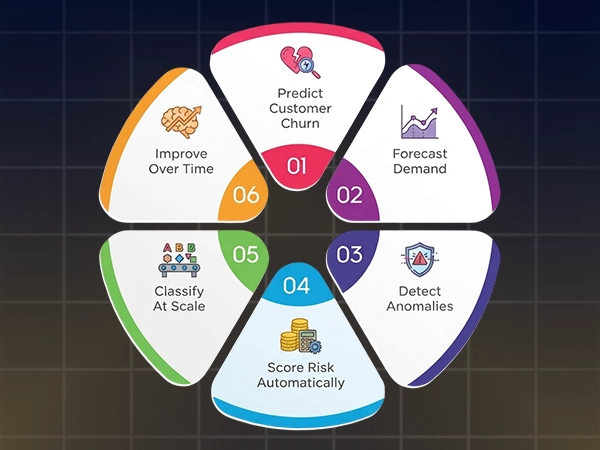
Years of order history, customer behaviour and past outcomes sit in your systems, mostly unused beyond a monthly report. A machine learning model studies these patterns and learns to predict future outcomes, such as identifying customers who may churn, orders that may be returned, or periods of increased demand, helping businesses use historical data for predictive analysis rather than historical reporting. Arrowbyte supports businesses with:
Predict Customer Churn
Flag at-risk customers before they leave
Forecast Demand
Anticipate stock needs before shortages happen
Detect Anomalies
Spot unusual patterns that may not be identified through manual review
Score Risk Automatically
Rank transactions or applications by risk level
Classify At Scale
Sort large volumes of data accurately and efficiently
Improve Over Time
Model accuracy can improve through ongoing retraining with new data
Model Performance Depends On The Quality Of The Training Data
A model trained on incomplete or biased historical data may reproduce those same limitations in its predictions. Arrowbyte evaluates the training data carefully before building a model, because data quality directly affects prediction accuracy. Arrowbyte builds models using your historical business data and monitors their performance after deployment, so predictions remain reliable over time. If you have historical data that could support more informed business decisions, contact our team for a free machine learning consultation.

Machine Learning Models Require Ongoing Monitoring
Customer behaviour changes over time, and a model trained on historical patterns may become less accurate if it is not reviewed and updated regularly. Continuous monitoring helps identify changes in performance as business conditions evolve.
- Biased training data produces biased predictions.
- Model accuracy can decline as behaviour changes.
- Incorrect predictions can reduce decision accuracy.
- Limited monitoring can delay the identification of declining model performance.
Building Machine Learning Models You Can Trust
- Check training data for gaps and bias before building the model
- Test the model against data it has never seen before
- Set a minimum confidence threshold before predictions are used in business decisions
- Monitor accuracy after deployment, not just during initial testing
- Retrain periodically, since customer behaviour changes over time
- Keep human oversight for high-impact predictions
Services
+61 491 979 548